Dane County 2027 Budget: What's at Stake for Urban Triage
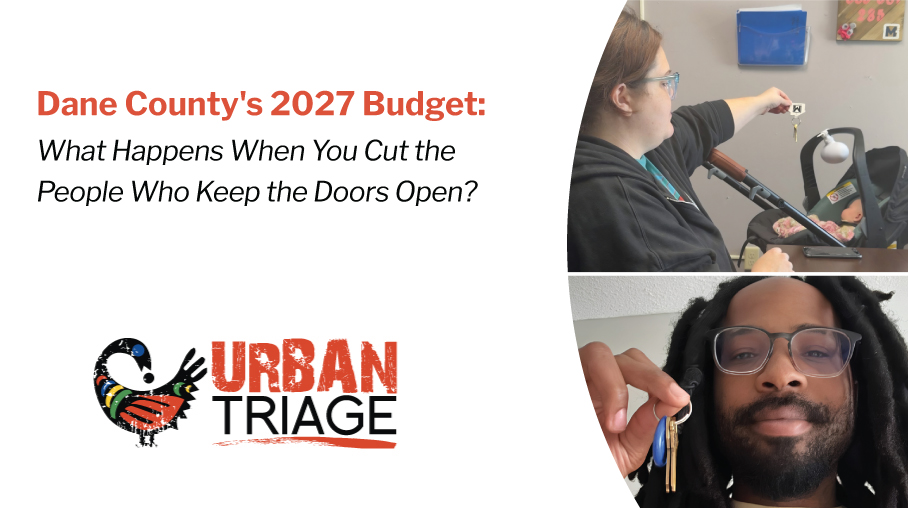
Dane County's 2027 Budget: What Happens When You Cut the People Who Keep the Doors Open?
Dane County is proposing to eliminate $321,520 in funding for Urban Triage in 2027. But the consequences extend far beyond that number. These county dollars also help us leverage federal housing resources, meaning the proposed reduction could jeopardize approximately $900,000 in combined funding and housing assistance.
The proposed cuts include $233,732 for Housing Navigation and $87,788 for Supporting Healthy Youth. These dollars sustain the staff, relationships, and infrastructure that allow us to serve people experiencing homelessness, support young people in crisis, and connect residents to housing and essential resources.
And behind every dollar is a person who needs somewhere to turn.
This conversation did not begin with the latest budget proposal. In Madison Loves Me. Madison Does Not Like Me., our founder and CEO, Brandi Grayson, examined the systemic questions surrounding the proposed elimination of Urban Triage's housing services. Her October 14 column, Thirty-three Empty Chairs and One Open Door, goes further, examining the potential loss of housing resources and the responsibility of county leadership to consider the full consequences of these decisions.
In the first six months of 2026, Urban Triage documented 14,352 community connections, including 11,847 triage conversations by phone, text, and email. During that same period, we permanently housed 71 individuals and families experiencing chronic homelessness and significant housing barriers. As of August, 85% remained housed.
Those numbers represent people who found someone willing and equipped to help them navigate systems that are often difficult to access, even under the best circumstances.
Yet as Dane County prepares its 2027 budget, the funding supporting this work is on the chopping block.
We believe the public deserves to understand what is at stake and what we are asking county leadership to consider.
1. Recognize the People Already Coming Through Our Doors
Urban Triage is not asking Dane County to fund an idea or an untested program. We are asking the county to recognize an existing community resource that thousands of residents already use.
People call us when they are facing eviction, sleeping in their cars, moving between family members' homes, fleeing violence, or trying to find stability for their children. Parents call about their teenagers. Young adults reach out because they have nowhere safe to sleep. Public agencies, schools, and other organizations refer people to us because they know we will respond.
These relationships were built through years of consistent work, not through a contract award.
When people make public funding decisions, those already relying on those services must be part of the equation.
2. Understand That Trust Cannot Be Transferred With a Contract
Funding can be reassigned. Contracts can be rewritten. But you can't package community trust and hand it to another organization.
Urban Triage has spent years developing relationships with residents who have often been turned away, misunderstood, or exhausted by systems that require them to repeatedly explain their circumstances.
People reach us through our office, our Digital Doorway, community outreach, and referrals from public agencies and nonprofit partners. Our Housing Services provide one of the pathways through which residents receive support.
Those relationships are part of the infrastructure that makes services accessible.
When funding changes, the question cannot simply be which organization receives the money. It must also be what happens to the people who already know where to go, whom to call, and whom they trust.
A budget can move dollars overnight. Rebuilding community trust can take years.
3. Fund the Actual Work of Getting People Housed
Housing Navigation is not simply handing someone a list of apartments or referring them to another agency.
It means working with people who face eviction histories, damaged credit, limited income, disability-related barriers, discrimination, and a housing market that often excludes them before they ever complete an application.
It means finding landlords willing to work with our participants, coordinating documentation, locating financial assistance, addressing barriers, and remaining involved long enough for a housing opportunity to become a home.
In six months, Urban Triage permanently housed 71 individuals and families. As of August, 85% remained housed.
That outcome required staff, time, expertise, relationships, and financial resources.
Urban Triage also contributes approximately $250,000 annually in private and unrestricted funding toward rental assistance because public resources alone do not meet the need.
We are already investing beyond our government contracts to help families secure housing. County funding supports the capacity needed to put those resources to work.
If Dane County wants measurable housing outcomes, the budget must account for the work required to produce them.
4. Protect the Funding Infrastructure That Brings More Resources Into Dane County
The proposed $321,520 reduction does not exist in isolation.
Urban Triage uses local investments to help support the staffing and infrastructure necessary to administer additional programs, including federally funded housing services. County dollars can also serve as eligible matching resources for federal awards.
Eliminating local funding can therefore create consequences beyond the original reduction, including risks to matching commitments, service capacity, and our ability to maintain or pursue additional funding.
This is why the conversation must extend beyond how much the county proposes to save in one budget line.
It must include how much additional funding could be affected, which services could be disrupted, and what it would cost to replace the capacity already operating in our community.
A sustainable funding model should account for those consequences before decisions are finalized.
The Budget Is Not Final. The Consequences Deserve Public Attention.
Urban Triage understands that Dane County faces difficult budget decisions. We also understand that public dollars must come with accountability, measurable outcomes, and responsible stewardship.
We welcome that scrutiny. Our work, records, and outcomes should be part of the discussion.
But accountability must extend to the budget process itself. Residents deserve to know what services are being reduced, what outcomes those services have produced, whether comparable capacity exists elsewhere, and what additional resources may be affected.
The 2027 budget process is still underway, and the public has opportunities to participate.
You can review upcoming Dane County budget meetings, identify your County Board supervisor, and ask how the proposed reductions would affect housing navigation, youth services, and federal funding partnerships.
For the thousands of people who have reached out to Urban Triage, this is not an abstract budget discussion. It is about whether the help they know how to access will still be there when they need it.
We are not asking the county to overlook difficult financial realities. We are asking that they examine the full cost of these decisions, including the human cost, before they become permanent.
The people we serve are not line items. The relationships that make this work possible are not interchangeable. And the outcomes we have produced did not happen by accident.
Dane County residents deserve a budget conversation that accounts for all three.
Fund the living. Keep the door open. Keep Urban Triage at the table.
Stay Connected with Urban Triage
Join our mailing list to receive the latest news, events, and exciting opportunities from Urban Triage, straight to your inbox!